Learn more about
German Physiks
Crafted for purity, designed for perfection
Although the first loudspeaker to bear the German Physiks name appeared in 1992, the history of the product predates this by several years. Scroll down to read on and find out more.
German Physiks – The beginning
Peter Dicks, a German engineer who had no prior involvement with the audio industry, had been interested in the fundamental problems of audio transducer behaviour for several years. He was particularly interested in the Walsh omnidirectional driver that was used in the loudspeakers made by the US Ohm Acoustics Corporation. This complex design worked in a way that was completely different to the conventional drivers used by the vast majority of loudspeaker manufacturers.
Dicks used his mathematical and engineering skills to make a computer model of the Walsh driver. With this he was able to fully understand how it worked. It also allowed him to see what its limitations were. He then worked towards a new and more advanced design, optimising the large number of parameters involved. After several years of making prototypes and fine tuning his computer model, he finally had a working design that he was happy with.
He showed his protype driver to a number of European loudspeaker makers, but none showed any interest. It was only in the early 90s, that he was contacted by a German company called Mainhattan Acustik, run by Holger Mueller, an audiophile and IT expert. Mainhattan Acustik made high quality loudspeaker systems and they also supplied drivers to a number of leading high-end audio manufacturers.

Mueller, was immediately impressed with Dicks’ prototype
He had the highest regard for the Walsh driver and had always felt that it had enormous untapped potential. At that time, he owned a pair of Ohm F loudspeakers that used the Walsh driver. As he examined the prototype, he saw that much of that potential had now been realised. Mueller agreed to license the design, and thus German Physiks was born.
The first task was to turn the prototype driver into a commercial product. For the next two years they worked to optimise the driver’s performance. It was also given a name; the DDD driver.
Not satisfied with superb laboratory measurements and the unbridled enthusiasm of his listening panels, Mueller initiated an exhaustive life-testing program to ensure the absolute reliability of the driver under the most severe conditions of use. In parallel Dicks worked on optimising the computer model and the fine details of the driver. Mueller also worked on the driver’s aesthetics.
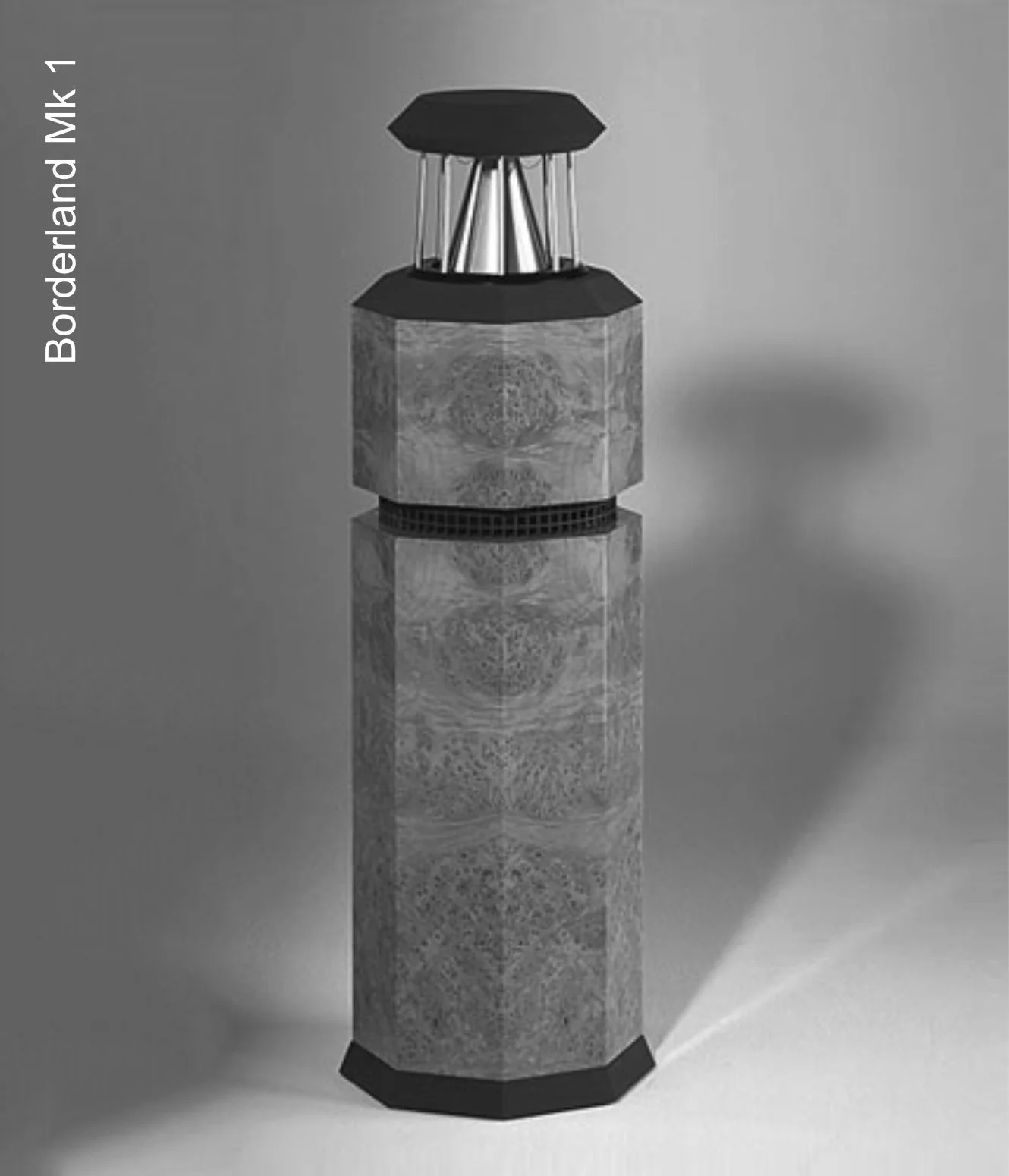
Finally in 1992, Mueller was satisfied and the first loudspeaker to use the DDD driver came off the production line. This was the Borderland Mk I and it was marketed under a new brand name: German Physiks.
The Borderland Mk I met with immediate approval, quickly gaining sales in the Far East, a region that had historically been an excellent, but demanding market for high-end audiophile products. The rest is, as they say, history.

German Physiks - Today
The German Physiks range of omnidirectional loudspeakers currently comprises 8 models and runs from our entry level HRS-130, to our flagship Gaudi Mk III. This starts at Euro 755,000 per pair and is designed to bring the listener as close as possible to the experience of a live performance in the comfort of their own home.
This is an impressive loudspeaker, both technically and visually. It is a 3-way, active design. Each section is driven by its own external power amplifier. To facilitate this, it is supplied with our own Emperor Extreme DSP-X digital crossover. The customer is free to use the amplifiers of their choice, though our preference is for our own Emperor electronics. We are, as you would expect, biased here.
The Gaudi Mk III uses the same 4 DDD driver array as the Gaudi Mk II, but has a completely redesigned and very much improved bass system. It has a frequency response extending down to 18Hz, can produce sound levels up to 118dB and fill rooms up to 300 square metres (3,200 square ft) in size.
To complement the exceptionally high level of resolution and musicality provided by our loudspeakers, in 2018 we launched our Emperor range of high-end electronics. The many excellent reviews these have since received show that they have more than met their objective. They will of course also give excellent results with other makers’ loudspeakers. The Emperor components provide the user with the flexibility to configure their system’s amplification however they wish.
As having a clean source of power is key to obtaining the best performance from any audio electronics, in 2019 we introduced our Pion power cable. This features a unique conductor design that acts as a high frequency noise filter.