German Physiks Newsletter No. 26 $$PLAIN_TEXT_PREVIEW$$

July 2021 | Newsletter No. 26

A trip down memory lane

Welcome to the July 2021 German Physiks newsletter.

This month we thought we would take a trip down memory lane and look at some of the very early German Physiks loudspeakers and how these designs evolved into some of our current models.

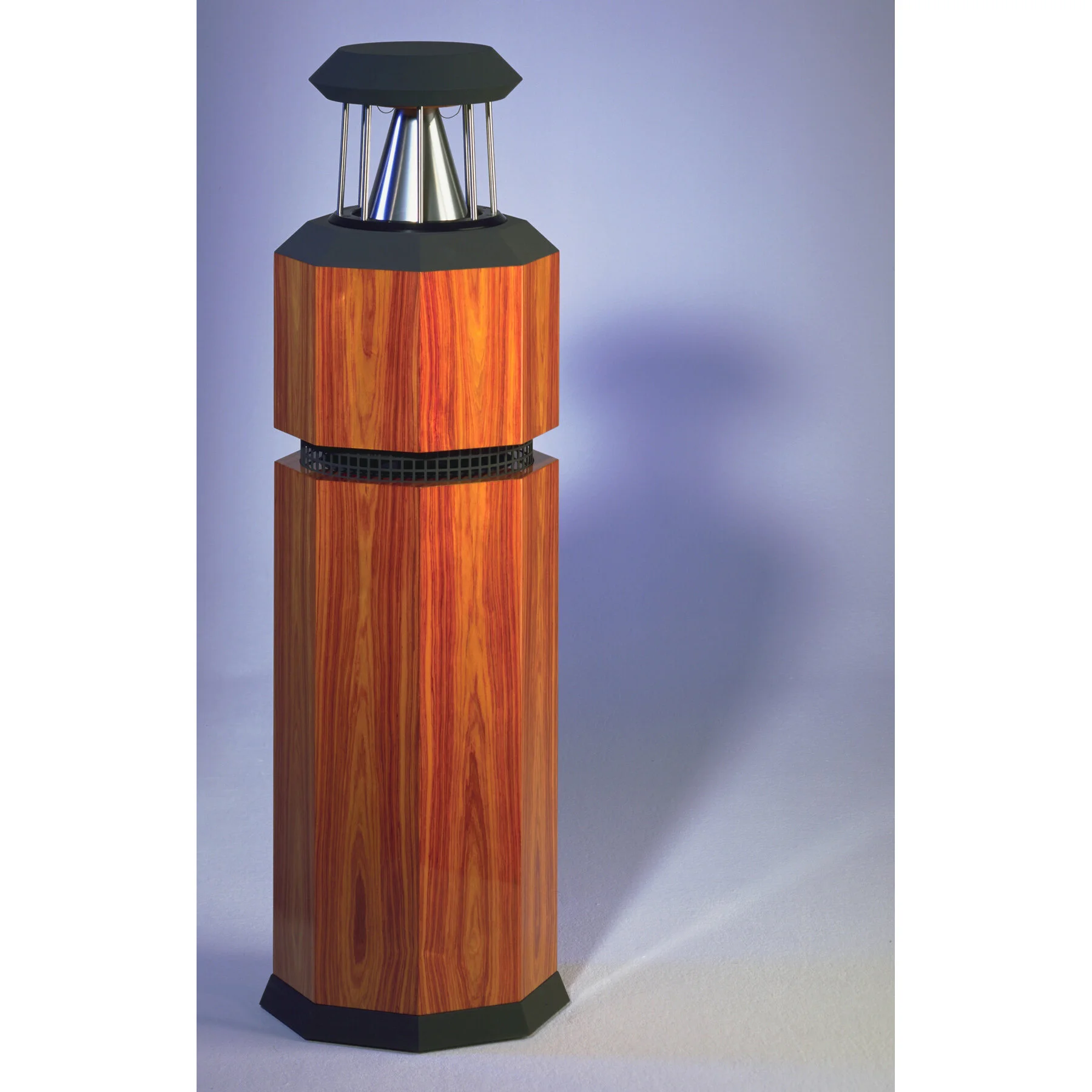
German Physiks Borderland Mk I
1992-1999

The first German Physiks loudspeaker was the Borderland Mk I. It used one titanium DDD driver and on this model it covered 270Hz to 19kHz. The bass was taken down to 28Hz by two 20cm woofers operated in an isobaric arrangement that vented through a circumferential grill near the top of the cabinet. The Borderland Mk I sold particularly well in the Far East: a market that has traditionally been very accepting of unorthodox designs. The Borderland Mk I’s only weakness was its titanium DDD driver. Whilst it offered excellent sound quality, the diaphragm was made from titanium foil that was just 0.001 inch thick (0.025 mm) which made it quite fragile. This also made it time consuming to manufacture, as it had to be handled very carefully. Unlike the Walsh driver, which was the inspiration for the design of the DDD driver, the most common cause of failure was not being over-driven, but people touching the diaphragm, or attempting to dust it. We can repair or provide a replacement DDD driver for any German Physiks loudspeaker, including the Borderland Mk I and changing the driver on all these models is a simple task that can be completed in a few minutes.

The basic design of the Borderland continues today in the Mk IV version and throughout the 29 years of the Borderland’s production, it has consistently been our most popular model. It now uses a carbon fibre DDD driver that offers a much wider frequency response: 190Hz to 24kHz. The carbon fibre DDD driver is also much more rugged than the original titanium version and will withstand all but the most determined attempts to destroy it. Please have a look at the video here to see what we mean. The bass is now handled by a single downward firing 12-inch woofer located in the bottom of the cabinet, which takes the response down to 28Hz

When the Borderland Mk IV was reviewed in The Absolute Sound magazine earlier this year by Matt Clott, his conclusion showed that it was still a very capable loudspeaker:

“Built to very high standards and offering an impressive array of sonic attributes that will satisfy both the ardent audiophile and the music lover, the Borderland’s unique styling and omnidirectional sound place this German delight on the must-audition pedestal.”

Visit the Borderland Mk IV web page.

Read Borderland Mk IV in review in The Absolute Sound here.

German Physiks Windspeil
1992-1999

The need for a model below the Borderland Mk I prompted the launch of the Windspeil (wind chime). This used the same titanium DDD driver as the Borderland Mk I, this time covering 140Hz to 19kHz. The bass was handled by a 20cm woofer mounted on the front of the cabinet driving a vented enclosure, with the port also on the front of the cabinet. The bass enclosure comprised two Helmholtz resonators tuned to different frequencies. This arrangement provided a smoother bass response than would be obtained with a simple vented system.

In 1998 the Windspeil was reviewed by Dan Sweeney in The Absolute Sound (issue 113). While he admitted that the design was not perfect, he wrote:

“I’ve spent more time listening to this system than with any other I’ve reviewed and I’ve never enjoyed a speaker so much.”

“Still warts and all, this is the most beguiling speaker I’ve met, and I’m hopelessly addicted to it.”

Dan was so impressed with the capability of the Windspeil’s DDD driver that he purchased another German Physiks design, the Unicorn Mk I. This used a single titanium DDD driver coupled to a horn system to cover 40Hz to 21.5kHz - nearly 9 octaves. You can find out more about the Unicorn Mk I and the later Mk II version in our newsletter No 5.

Dan Sweeney also reviewed the Unicorn Mk I in issue 120 of The Absolute Sound. If your collection of this magazine goes back this far, it is worth digging out.

German Physiks Unlimited
1992-2001

The first Unlimited design, although it used a square section floor standing cabinet, was different in a number of ways from the current Unlimited Ultimate.

It used a single titanium DDD driver operated from 120Hz to 19kHz. To provide a more omnidirectional characteristic at the low end than the Windspeil, it used an isobaric arrangement similar to the Borderland Mk I, employing two 18 cm woofers, that vented through a circumferential grill near the top of the cabinet. This took the bass down to 28Hz.

Making a loudspeaker at a price point below the Borderland Mk I was a constant challenge. It used the same DDD driver, which itself was expensive to manufacture and a complicated cabinet and the high cost of the other parts added to the difficulty. Consequently, the Unlimited was discontinued in 2001.

German Physiks Legato
2001-2005

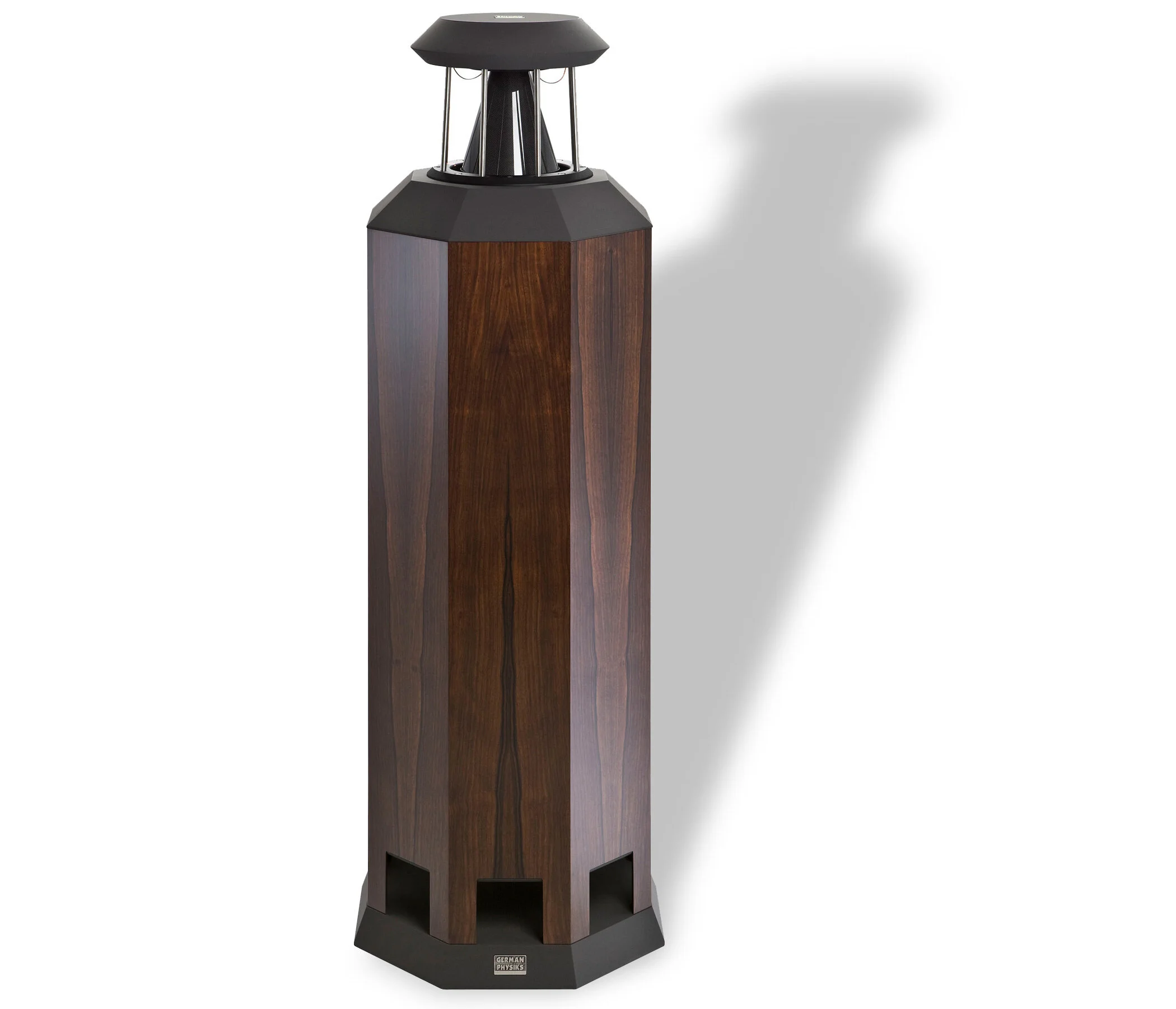
The Legato was the next step in the simplification of the design that was eventually to lead to the current Unlimited Ultimate. It used a single titanium DDD driver operated from 155Hz to 19kHz. The bass was handled by a downward firing 20cm woofer located at the bottom of the cabinet and it radiated through openings at the front and rear of the cabinet’s base. This arrangement of a downward firing woofer working into a sealed enclosure provided a superior bass than the earlier isobaric arrangement, which is why is was used on the later Borderland and Unlimited Mk II/Ultimate designs. It was also simpler to manufacture and on the rare occasions when a customer managed to blow up a woofer, replacing the driver was very much easier. As with the Unlimited, manufacturing costs eventually caught up with the Legato and it was discontinued in 2005

Not willing to be defeated, the designers at German Physiks continued to look at ways to make a high quality entry level loudspeaker that would use the DDD driver and not compromise on the potential it offered. In 2011, the Limited 11 was introduced. An initial run of 100 pairs was made to test the market. The Limited 11 used the the new carbon fibre DDD driver. This offered a wider bandwidth than the earlier titanium version and was operated from 200Hz to 24kHz. Veneer finishes were ruled out due to cost, so the square section cabinet was finished in a special acoustic vinyl, which was offered in only one colour - grey. A single 20cm downward firing woofer working in a sealed enclosure and located the bottom of the cabinet took the response down to 32Hz.

The base plate used in earlier designs was dispensed with, providing a cost saving, so the woofer fired directly out of the cabinet. It was soon discovered by users that they could tweek the bass by putting spacers under the spikes to raise the woofer further from the floor.

The 100 pairs sold out more quickly than expected and due to demands from a number of distributors the design was brought back as the Unlimited Mk II and it was offered finished in acoustic vinyl in grey, black, white and brown.

What we termed acoustic vinyl was actually a high quality flooring vinyl. Far from being a cheap finish, the material used was in fact more expensive per square metre than veneer. As it required less surface preparation and other than trimming the edges after being applied to the cabinet, it didn’t require the extra work that a veneer finish needed, the overall cost was lower.

The vinyl had two more useful advantages. The material used was comprised of two layers. An under-layer of sound deadening material that helped to damp cabinet vibrations and hard wearing outer layer that was very resistant to scratches and bumps.

In 2014 two new versions of the Unlimited design were introduced. One with a luxurious high polyester finish, the Unlimited Ultimate and the other with a carbon fibre finish, the Unlimited Carbon. By 2018, despite the higher cost, most Unlimited sales were accounted for by the Unlimited Ultimate, so the Unlimited Mk II was discontinued.

That brings us up the present day.

Visit the Unlimited Ultimate web page.

Until next time…

Thank you again for signing up to our newsletter and thank you for your continued interest in our products. Please don’t forget to visit our Facebook and Instagram pages.

If we can be of help with anything at all, please do not hesitate to get in touch with us here. You can find your national distributor here.

Holger Mueller | German Physiks

twitter facebook instagram

DDD-MANUFACTUR GMBH, GUTENBERGSTRASSE 4, 63477, MAINTAL, Germany

Unsubscribe