|
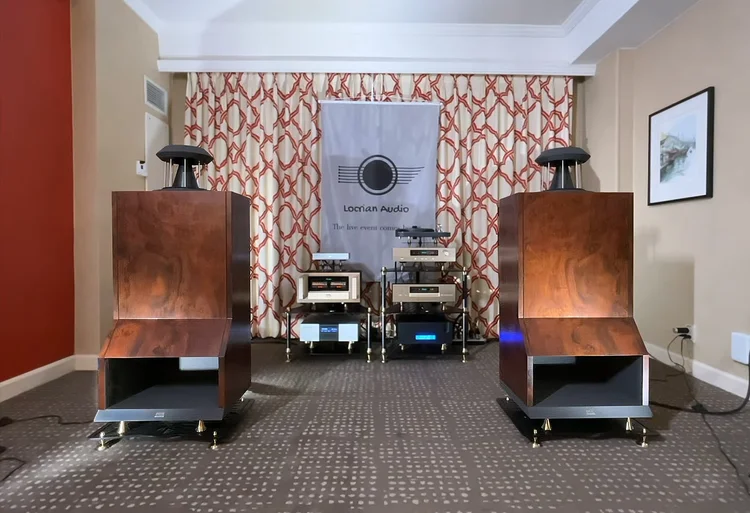
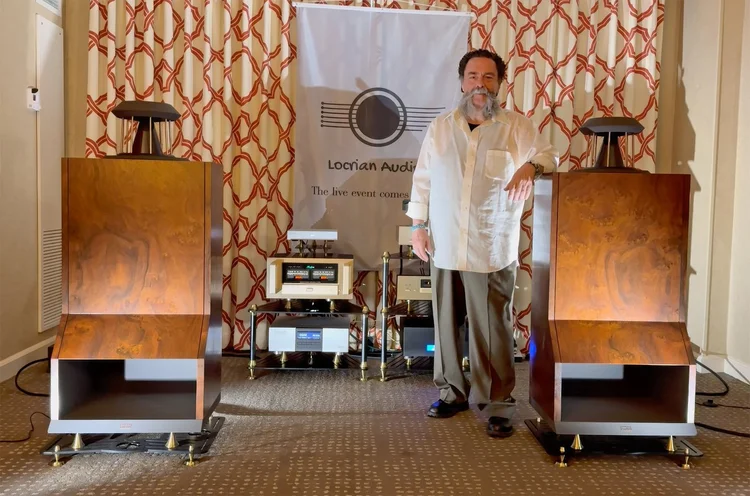
Originally the Unicorn was not intended to become a commercial product. It was designed as an in-house exercise to see if it was possible to build a loudspeaker that used a single German Physiks DDD driver driven full-range. It would have remained an in-house curiosity were it not for a chance conversation between Holger Mueller, the owner of German Physiks and the US reviewer Dan Sweeney in 1997. Sweeney, who was unaware of the Unicorn’s existence, asked if such a loudspeaker could be built. Mueller described the experimental design and Sweeny asked when this would go into production. Mueller said never, as he thought its unconventional look would make it too difficult to sell. Sweeney then asked if Mueller would send plans for the design, so that he could have cabinets made in the US. These were sent, but due to their complexity, Sweeney was unable to find a cabinet maker willing to take on the job. Eventually Mueller agreed to make a custom set of the loudspeakers and brought them to the showroom of the then US distributor. There they were auditioned by a local high-end audio dealer who liked them so much that he ordered a set on the spot. Shortly afterwards, the Japanese distributor got to hear about this demonstration and they ordered a set. This prompted Mueller to add the design to the German Physiks loudspeaker line-up and thus the appropriately named German Physiks Unicorn Mk I was born. Over a number of years, further work was done on the design, resulting in the Unicorn Mk II. The main changes were an improved bass response and a revised cabinet with a forward-facing horn mouth that made it easier to position the loudspeaker in the room. As the Unicorn Mk I was selling steadily, mostly in Japan, the updated version was not put into production, but was used in the factory as a reference for transparency against which other designs were judged. In 1999, a Japanese audio reviewer, the late Okihiko Sugano, was visiting the German Physiks factory, when he heard the Unicorn Mk II. He was already very familiar with the Unicorn Mk I, but after hearing the improvement that the Mk II offered, he strongly advised German Physiks to put it into production. At that time, Mr. Sugano was the top reviewer for Stereo Sound, the most influential high-end audio magazine in Japan. It also had a significant readership in several other Far East countries, so his strong suggestion was not to be ignored. Initially the Unicorn Mk II was fitted with the same titanium DDD driver used on the Mk I. With this, the frequency response was flat between 55Hz and 21.5kHz. With the current carbon fibre DDD driver, the response limits have been significantly expanded and it is now flat between 40Hz and 24kHz.
The full story of the development the German Physiks Unicorn may be read in our Newsletter number 48. A detailed explanation of the how the Unicorn Mk II works may be found in our Newsletter number 5.
|