German Physiks Newsletter No. 28 $$PLAIN_TEXT_PREVIEW$$

September 2021 | Newsletter No. 28

Where did it all start?

Part 2 of 2

Welcome to the September 2021 German Physiks newsletter.

In the first part of this newsletter, which was sent out a few days ago, we looked at early omnidirectional loudspeakers, concentrating on designs from the US. This month we will look at:

  • How the Japanese makers responded to the growing interest in omnidirectional loudspeakers.

  • An omnidirectional loudspeaker from a most unexpected maker.

  • A current omnidirectional loudspeaker design using conventional drivers combined with diffusers.

Pioneer CS-05

The Japanese were not slow to see the potential in omnidirectional loudspeakers.

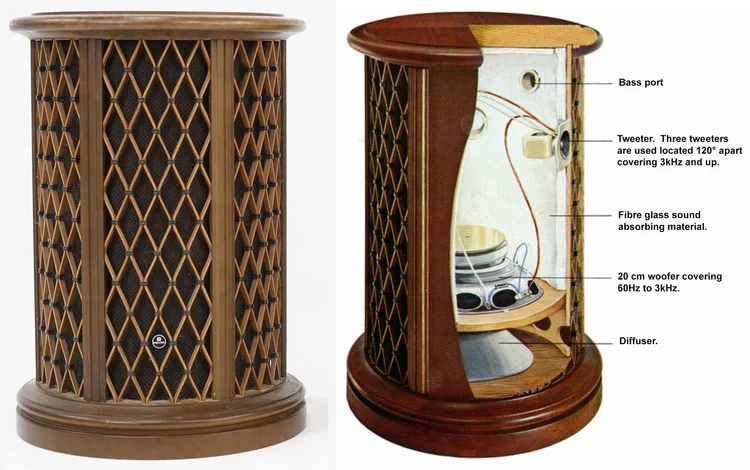
In 1969 Pioneer introduced their CS-05, which sold for Yen 30,000/pair. It used a 20 cm woofer located at the bottom of a ported cabinet, firing downwards into a diffuser. This covered the range from 60Hz to 3kHz. The woofer’s cone was constructed using paper manufactured using what the brochure described at the “FB process”. This was said to produce, “a harder, lighter paper, with longer fibres and greater stability” and which in turn was said to produce a clearer sound.

Three tweeters were located in the upper part of the cabinet, at 120 degree intervals, facing outwards.

A control on the underside of each loudspeaker allowed the high frequency response to be adjusted.

The cabinet was elegantly styled and beautifully made from walnut. Pristine examples still emerge on the used market in Japan from time to time.

The maker’s brochure extolled the loudspeaker’s ability to allow the listener to “really enjoy stereophonic in natural balance wherever in the the room you may sit, without listening fatigue.” This may have suffered a little in translation from the original Japanese, but the message is clear and it is still true of omnidirectional loudspeakers today.

A later and slightly larger version called the CS-06, used a 25 cm woofer and added three 10 cm mid-range units, one located between each of the tweeters.

Tannoy Orbitus 1

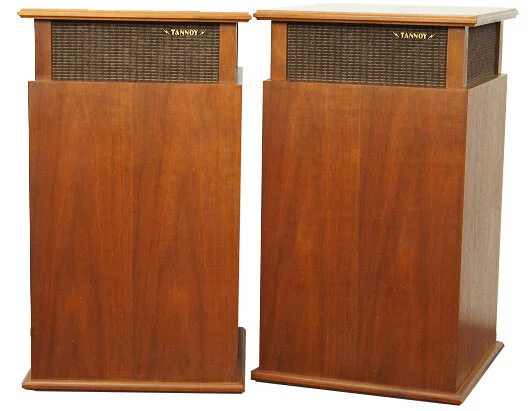
We were very surprised to find that even Tannoy, probably the most traditional loudspeaker maker on the planet, once made something as unconventional as an omnidirectional loudspeaker. Launched in 1971, the Tannoy Orbitus 1 used a specially modified version of their 12-inch dual concentric loudspeaker, mounted facing upwards near the top of the cabinet, above which was situated a diffuser shaped to mimic that of the driver cone. This deflected the sound energy horizontally and omnidirectionally around the loudspeaker. A port opening under the cabinet enabled the low frequency section of the loudspeaker to work as a bass-reflex design.

Two tone controls were located on the underside of the cabinet. One, a four-step switch, controlled the rate and amount of roll-off from about 2.5kHz and upwards. The other, a five-step switch, controlled the amount of high frequency energy radiated from about 1kHz and upwards.

The Orbitus 1 was priced in the U.S. at $245.

Sansui SF-1 & SF-2

In 1972, Sansui in Japan introduced their SF-1. Externally this bore a superficial resemblance to the Pioneer omnidirectional design, but the internal design was much more complex. It used two vertically orientated 16.5 cm woofers, positioned in the lower part of the cabinet in their own enclosure, arranged with their cones facing away from each other. The lower woofer fired directly at a diffuser which deflected its energy outwards omnidirectionally. Energy from the upper woofer passed through a porous material that filled most of the upper part of the cabinet, from where it was radiated outwards, omnidirectionally. The energy from the back of both woofers was radiated via a port. The quoted frequency response was 55Hz to 20kHz.

High frequencies were handled by an upward facing 58 mm tweeter in top of the cabinet that fired directly into its own diffusor.

Like the Pioneer CS-05, a tone control was located in the base of each loudspeaker. The price was Yen 33,600/pair.

Sansui referred to the SF-1 as the “Sound-in-the-Round speaker system” and it was marketed towards owners of the quadraphonic systems that were popular at the time. These used LPs with specially encoded signals as their main source. These could be played back in stereo using a standard cartridge, but would yield 4-channels when played back using a suitable cartridge connected to an appropriate decoder. A number of different and incompatible encoding schemes were used and this contributed to the format failing to take off.

Sansui also made a slightly larger version called the SF-2. This used two 20 cm woofers to extend the low end response to 50Hz.

In their marketing material, Sansui made much of the fact that indirect sound waves are a “vital element of the live convert hall sound field” and that the SF-1’s omnidirectional radiation characteristic allowed it to deliver the, “authentic “live” sound effect that so many speaker systems promise, but so few deliver”. This echos what Stewart Hegeman was saying 14 years earlier and it remains true today.

Up to the present day …

The use of a diffuser in conjunction with a conventional driver to create an omnidirectional sound field can be found today in a number of designs, the best known of which are those from the German company Dueval. On their entry level Planets model, they use a 6-inch woofer and a 1-inch tweeter, located side by side and facing upwards with individual spherical metal diffusers placed above to deflect the sound energy.

Their other models, such as the Venus shown above right, use a vertically opposed woofer and tweeter, with a shaped wooden diffuser to deflect the sound wave outwards.

The fact that more than 60 years after Stewart Hegeman first introduced this concept, it is still being used, is a tribute to his brilliance as an engineer.

Until next time…

Thank you again for signing up to our newsletter and thank you for your continued interest in our products. Please don’t forget to visit our Facebook and Instagram pages.

If we can be of help with anything at all, please do not hesitate to get in touch with us here. You can find your national distributor here.

Holger Mueller | German Physiks

twitter facebook instagram

DDD-MANUFACTUR GMBH, GUTENBERGSTRASSE 4, 63477, MAINTAL, Germany

Unsubscribe