German Physiks May 2022 newsletter͏‌ ͏‌ ͏‌ ͏‌ ͏‌ ͏‌ ͏‌ ͏‌ ͏‌ ͏‌ ͏‌ ͏‌ ͏‌ ͏‌ ͏‌ ͏‌ ͏‌ ͏‌ ͏‌ ͏‌ ͏‌ ͏‌ ͏‌ ͏‌ ͏‌ ͏‌ ͏‌ ͏‌ ͏‌ ͏‌ ͏‌ ͏‌ ͏‌ ͏‌ ͏‌ ͏‌ ͏‌ ͏‌ ͏‌ ͏‌ ͏‌ ͏‌ ͏‌ ͏‌ ͏‌ ͏‌ ͏‌ ͏‌ ͏‌ ͏‌ ͏‌ ͏‌ ͏‌ ͏‌ ͏‌ ͏‌ ͏‌ ͏‌ ͏‌ ͏‌ ͏‌ ͏‌ ͏‌ ͏‌ ͏‌ ͏‌ ͏‌ ͏‌ ͏‌ ͏‌ ͏‌ ͏‌ ͏‌ ͏‌ ͏‌ ͏‌ ͏‌ ͏‌ ͏‌ ͏‌ ͏‌ ͏‌ ͏‌ ͏‌ ͏‌ ͏‌ ͏‌ ͏‌ ͏‌ ͏‌ ͏‌ ͏‌ ͏‌ ͏‌ ͏‌ ͏‌ ͏‌ ͏‌ ͏‌ ͏‌ ͏‌ ͏‌ ͏‌ ͏‌ ͏‌ ͏‌ ͏‌ ͏‌ ͏‌ ͏‌ ͏‌ ͏‌ ͏‌ ͏‌ ͏‌ ͏‌ ͏‌ ͏‌ ͏‌ ͏‌ ͏‌ ͏‌ ͏‌ ͏‌ ͏‌ ͏‌ ͏‌ ͏‌ ͏‌ ͏‌ ͏‌ ͏‌ ͏‌ ͏‌ ͏‌ ͏‌ ͏‌ ͏‌ ͏‌ ͏‌ ͏‌ ͏‌ ͏‌ ͏‌ ͏‌ ͏‌ ͏‌ ͏‌ ͏‌ ͏‌ ͏‌ ͏‌ ͏‌ ͏‌ ͏‌ ͏‌ ͏‌ ͏‌ ͏‌ ͏‌ ͏‌ ͏‌ ͏‌ ͏‌ ͏‌ ͏‌ ͏‌ ͏‌ ͏‌ ͏‌ ͏‌ ͏‌ ͏‌ ͏‌ ͏‌ ͏‌ ͏‌ ͏‌ ͏‌ ͏‌ ͏‌ ͏‌ ͏‌ ͏‌ ͏‌ ͏‌ ͏‌ ͏‌ ͏‌ ͏‌ ͏‌ ͏‌ ͏‌ ͏‌ ͏‌ ͏‌ ͏‌ ͏‌ ͏‌ ͏‌ ͏‌ ͏‌ ͏‌ ͏‌ ͏‌ ͏‌ ͏‌ ͏‌ ͏‌ ͏‌ ͏‌ ͏‌ ͏‌ ͏‌ ͏‌ ͏‌ ͏‌ ͏‌ ͏‌ ͏‌ ͏‌ ͏‌ ͏‌ ͏‌ ͏‌ ͏‌ ͏‌ ͏‌ ͏‌ ͏‌ ͏‌ ͏‌ ͏‌ ͏‌ ͏‌ ͏‌ ͏‌ ͏‌ ͏‌ ͏‌ ͏‌ ͏‌ ͏‌ ͏‌ ͏‌ ͏‌ ͏‌ ͏‌ ͏‌ ͏‌ ͏‌ ͏‌ ͏‌ ͏‌ ͏‌ 
German Physiks

May 2022 | Newsletter No. 36

30 years of German Physiks

Welcome to the May 2022 German Physiks newsletter.

30 years ago, the first German Physiks loudspeaker, the Borderland Mk I went on sale. 30 years later, German Physiks is still here, as is the Borderland, though now in its Mk IV form. This month we thought we would take a look at some of our most distinctive products.

In the beginning …

Titanium foil diaphragm DDD driver

The spur to the founding of DDD-Manufactur GmbH, the company that makes German Physiks products, was the meeting of Holger Mueller, who would become the owner of the company, and a German engineer, Peter Dicks. Peter’s day job was nothing to do with audio, but he had for many years been interested in loudspeaker driver technology. One driver in particular fascinated him, the Walsh driver designed by US engineer Lincoln Walsh.

This was a full range, omnidirectional driver that was used very successfully over a number of years in the loudspeakers manufactured by the Ohm Loudspeaker company of New York. The best known of these was the iconic Ohm F loudspeaker.

Walsh’s design was not without its faults. Its diaphragm was constructed in three sections, which made it complicated and expensive to manufacture. It was also quite fragile, especially when driven hard, which was when the Ohm F really came alive.

Peter made a computer model of the Walsh driver, something that was not available when Lincoln Walsh made his original design and over a number of years he developed a new driver design that overcame the limitations of the Walsh driver and offered superior performance. A detailed description of the Walsh driver and the development of the DDD driver may be found in Newsletter 31 and Newsletter 34.

Peter showed his new design to a number of European loudspeaker makers, none of whom was interested. It was only in the late 1980s when Peter’s design came to the attention of Holger Mueller that things changed. At that time, Mueller had for many years been running a company making loudspeaker drivers and loudspeaker systems called Mainhattan Acustik. He was also a fan of the Walsh driver and the Ohm F. He saw the potential of Peter’s design and for the next two years they worked together to turn Peter’s prototype into a commercial product.

This culminated in 1992 with the founding of a new company, DDD-Manufactur GmbH, specifically to make loudspeakers using the DDD driver and the launch of their first product, the Borderland Mk I.

Borderland Mk I

German Physiks Borderland Mk I

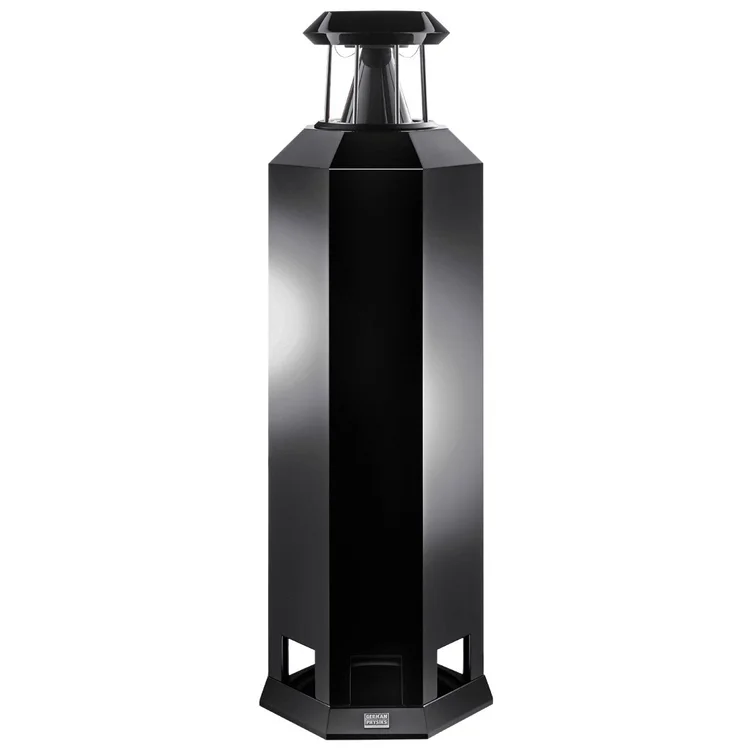
The Borderland Mk I used the first version of the DDD driver, which had a titanium foil diaphragm. In this application it covered the frequency range from 270Hz to 19kHz. Two 20cm woofers operated in an isobaric arrangement took the bass down to 28Hz. The new design was successfully received, especially in the Far East, where audiophiles have traditionally been more willing to accept unorthodox loudspeaker designs. This basic design went through three revisions until it was replaced in 2007 and with the current version, the Borderland Mk IV.

The Borderland Mk IV uses the same octagonal cabinet design, but with a downward firing 12-inch woofer mounted at the bottom of the cabinet replacing the earlier isobaric arrangement. This works into a sealed enclosure. A small additional enclosure is located above the bass enclosure and the two are linked by a small opening. This secondary enclosure is tuned to a harmonic of the bass enclosure resonance and acts as a Helmholtz resonator. Because it is packed with damping material, it suppresses the bass enclosure’s main resonance, producing a smoother low end response. The Borderland Mk IV was also offered with a new version of the DDD driver. This used a carbon fibre diaphragm instead of the original and rather fragile titanium one. The Borderland Mk IV’s carbon fibre DDD driver has a much wider frequency range - 190Hz to 24kHz. This gives better coherence; better dynamics due to a higher maximum output level and it is extremely resistant to physical abuse. To see how much abuse a carbon fibre DDD driver can withstand please watch this video.

Improvements have been made to the design of the carbon fibre DDD driver over the years and this is now standard on all German Physiks loudspeakers.

The Borderland Mk IV has received a number of small updates over the years and it remains our most popular loudspeaker. It combines a very high level of performance with a comparatively compact cabinet, to produce a loudspeaker that gives equivalent priced (and higher priced) competitors something to think about. This is illustrated by a comment from Robert Grubstad, the owner of our Swedish distributor Audio Concept after demonstrating the Borderland Mk IV at a recent audio show:

“It was a phenomenal setup and people were mesmerised by the sound.... I love the DDD driver now that I have spent more time listening to it.”

German Physiks Borderland Mk IV


Visit the Borderland Mk IV web page

Unicorn Mk I

German Physiks Unicorn Mk I

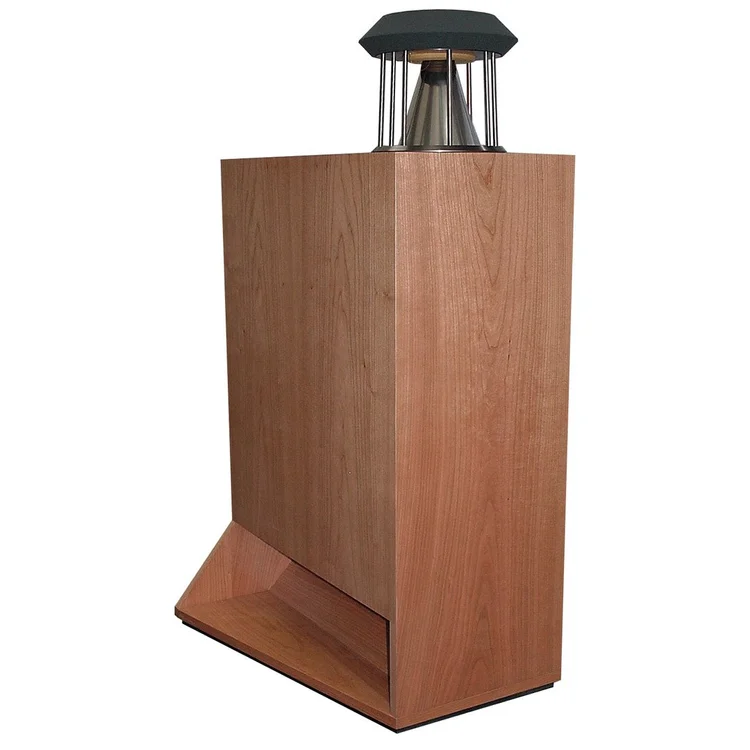
The Unicorn Mk I was originally made as an experiment to see if a full range loudspeaker could be made using just one DDD driver. For the DDD driver to work, it has to have a surround that is much stiffer than a conventional driver. This restricts the cone movement at low frequencies, which in turn restricts its low frequency output. The obvious solution to extending the DDD driver’s low end response was to couple it to some sort of horn system. The final solution proved more complicated and comprised:

  • A high gain horn with a bass trap located in the throat of the horn.

  • An external electrical equalising network.

In July 1998, a review of the German Physiks Windspeil loudspeakers written by Dan Sweeney was published in the US magazine The Absolute Sound. He liked them so much that he subsequently bought a pair. He became aware of the Unicorn experiment and requested a set of drawings from Mr. Mueller, so that he could have a pair of cabinets made in the US. Unfortunately he could not find a cabinet maker who was willing to make them, as they were too complicated. A year later a pair of Unicorn Mk Is was shipped to the showroom of the US distributor at that time. A US audio dealer heard them and placed an order. Then a Japanese audio dealer heard about them and placed an order sight unseen. This convinced Mr. Mueller to make the Unicorn Mk I a regular part of the German Physiks like-up.

The Unicorn Mk I was reviewed by Dan Sweeney in the October 1999 issue of The Absolute Sound where he concluded:

“…this is the most beguiling speaker I have ever met, and I am hopelessly addicted to it.”

The Mk I had to be placed well away from side walls as the bass output from the horn was radiated by openings on the left and right of the cabinet. The cabinet on the Mk II version was redesigned so that the bass radiated from one opening in the front. It was also made available with the higher performing carbon fibre diaphragm DDD driver.

Arguably the Mk I is the prettier of the two versions, but undoubtedly the Mk II is the better sounding, especially now that a DSP equalisation network is available to replace this original passive equaliser. This is installed between the pre and power amplifier in a separates based system, or in the tape-loop or home theatre by-pass of an integrated amplifier.

German Physiks Unicorn Mk II

Visit the Unicorn Mk II web page

Gaudi Mk I

German Physiks Gaudi Mk I

The Gaudi Mk I was another loudspeaker that was originally designed as an experiment. The objective in this case was to see how close to live-music-like sound levels and dynamics a German Physiks loudspeaker could get. The final design was able to produce sound levels up to 120dB, which allowed quite large ensembles to be realistically reproduced. The initial driver line-up was:

  • 4 x titanium DDD drivers

  • 8 x 6-inch woofers

  • 4 x 12-inch woofers

To allow the loudspeaker to be better matched to the particular room it was to be used in and also to achieve better driver control, it was designed as an active system and supplied with a custom designed analogue active crossover.

As each Gaudi weighed 720kg (1,600lbs), adjusting the loudspeaker’s position was going to be a challenge. Luckily the very wide bandwidth of the DDD driver provided a solution. The DDD driver array is mounted on a motorised beam that can be commanded to move backwards and forwards from the listening seat using an infra-red remote control. As the DDD drivers on the Gaudi cover almost the entire audio range*, moving the DDD drivers is essentially the same as moving the whole loudspeaker, only a lot easier and quicker.

We thought that this loudspeaker would be too big and too expensive to be commercially viable, but after carrying out a few demonstrations in Germany we began to receive serious enquiries, so the Gaudi joined our our product line-up. The Mk III version of the Gaudi is under development. The Covid pandemic has caused this to be delayed, but we hope to have it ready some time next year.

*Titanium foil DDD driver 180Hz to 21,500Hz; carbon fibre DDD driver 180Hz to 24,000Hz.

German Physiks Emperor Mk II showing moveable DDD driver array

The Gaudi Mk I and the later Gaudi Mk II have achieved a respectable number of sales over the years, but its size has been a problem in a number of cases, so we designed a slightly smaller version of the Gaudi, called The Emperor. This has the same moveable 4-DDD driver array and bass cabinet arrangement, but it will fit into smaller rooms. That said it can comfortably drive rooms up to 200 sq m (2,100 sq ft). Like the Gaudi, the Emperor is also a 3-way active loudspeaker and is now supplied with our Emperor DSP-X digital active crossover as standard. This provides a higher level of quality than the original analogue unit used with the Gaudi and being digital based, it has a much wider range of adjustment, allowing its response to be better tailored to suit the user’s room.

Visit the Emperor Mk II web page

Visit Emperor DSP-X active crossover web page

In the pipeline

  • An online review of the Emperor integrated amplifier.

  • A comparison of our DDD driver with another omnidirectional driver.

  • Announcements of the appointments of new distributors.

Until next time …

Thank you again for signing up to our newsletter and thank you for your continued interest in our products. Please don’t forget to visit our Facebook and Instagram pages.

If we can be of help with anything at all, please do not hesitate to get in touch with us here. You can find your national distributor here.

Holger Mueller | German Physiks

twitter facebook instagram

DDD-MANUFACTUR GMBH, GUTENBERGSTRASSE 4, 63477, MAINTAL, Germany

Unsubscribe