German Physiks Newsletter No. 27 $$PLAIN_TEXT_PREVIEW$$

August 2021 | Newsletter No. 27

Where did it all start?

Part 1 of 2

Welcome to the August 2021 German Physiks newsletter.

We thought we would look back to when omnidirectional loudspeakers first appeared and specifically to designs that used a conventional driver firing into a diffuser to produce the omnidirectional sound field. This is not meant to be a comprehensive catalogue of this type of loudspeaker, rather the high-lights of some of the more notable designs.

Because of the length of the original version of this newsletter, we have decided to split it into two parts and we will send the second part out in a few days. Hopefully the first part will whet your appetite for the second.

Eico HSF-2

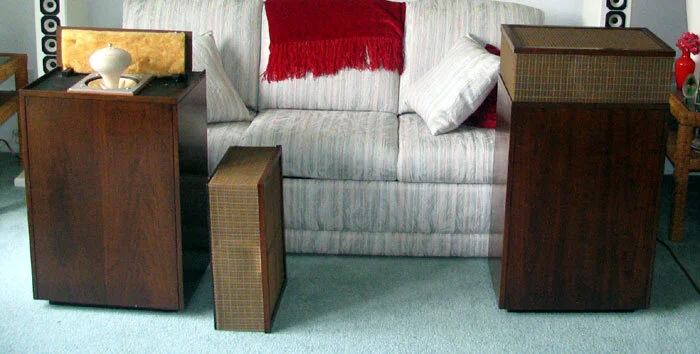
The idea of omnidirectional loudspeakers is not new. The earliest one that we are aware of is the American Eico HSF-2, from 1958. It was designed by the prolific American audio engineer, Stewart Hegeman, who also designed the Harmon-Kardon Citation II amplifier and the original Dynaco tuner. The Eico HSF-2 used a vertically firing 8.5-inch woofer, with a diffuser mounted directly over the cone to defect the sound waves outwards. The back of the woofer was coupled to a slot loaded conical horn, a technique that was invented and later patented by Hegeman. The tweeter was mounted directly above the woofer. Unusually this had a cone shaped rather like a lily flower. This was apparently done to give the tweeter a wider frequency response. Set inside the tweeter cone was a plug that deflected its radiation outwards.

In an article for the magazine Radio Electronics, Hegeman said that two of his objectives in designing the HSF-2 were:

  • To create a loudspeaker with an omnidirectional radiation pattern, to avoid the beaming of the mid-range and high frequencies that occurs with conventional loudspeakers, which he said caused, “unpleasantness and lack of naturalness in reproduction caused by the loss of the spatial characteristics typical of live sound”.

  • To create a loudspeaker that was phase linear, thereby accurately preserving the phase relationships of all the individual tones that make up the complex musical signal.

This was quite a complex design and it took Hegeman three pages in the article in Radio Electronics to summarise. The complexity was also reflected in the price, which in 1958 was $139.95.

Harman-Kardon Citation X

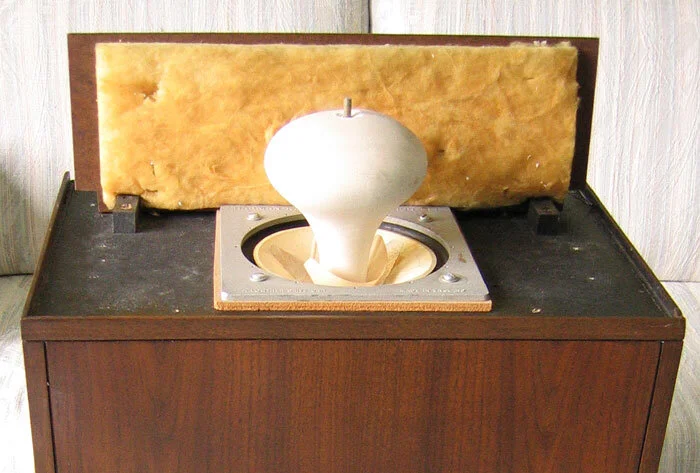
In 1960, Harman-Kardon launched their Citation X at the New York Audio Show. This was also designed by Stewart Hegeman. As with the Eico HSF-2, Hegeman wanted to recreate the sense of spatiality experienced at a live performance. To do this he sought to replicate the sound field produced in a good concert hall, where 80% of the sound is reflected off walls and ceilings and just 20% is direct. The design used a modified 6.5-inch Lowther driver firing vertically, with a diffuser made of plaster, placed directly over it to deflect the sound waves outwards. The board covered with absorbing material behind the diffuser meant that the shape of the radiation pattern was close to a quarter-sphere. The back of the driver was coupled to a folded horn, that vented through a slot in the base of the cabinet. The cabinet was made from particle board covered with a walnut veneer. The Citation X was priced at $250.

The picture above shows a close up of the diffuser on the Citation X.

Harman-Kardon later released a number of other omnidirectional designs using a similar diffuser technique.

Zenith Circle of Sound Series

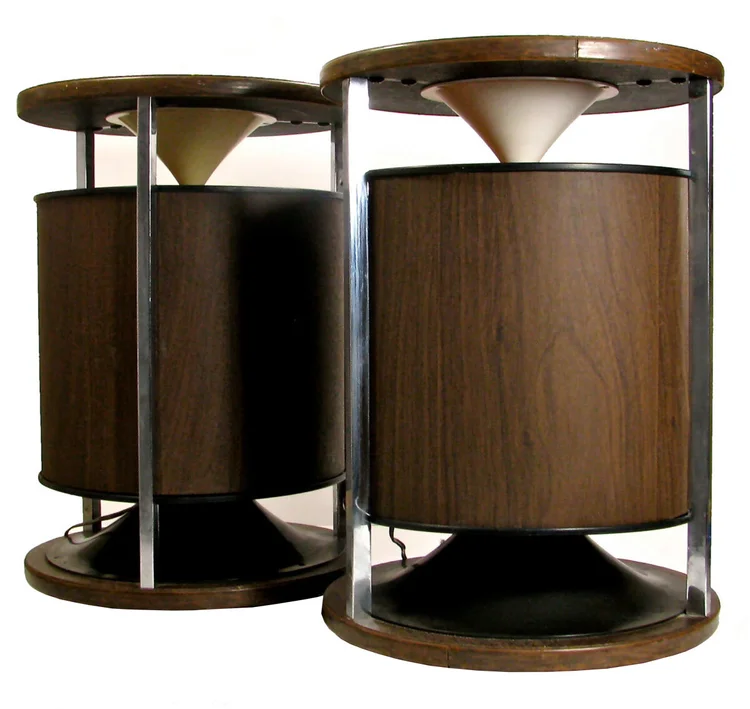
Omnidirectional designs were not limited to the high-end of the market. In 1968 Zenith introduced their Circle of Sound loudspeaker, which was sold as part of their mass market Troubador Z590 ($279) and Moderne Z565 ($200) hi-fi systems. Both systems included a turntable and amplifier. The Troubador also included an FM tuner. The first version of this loudspeaker used a 6-inch woofer, firing upwards towards a plastic diffuser to create the omnidirectional sound field. This driver was operated without a crossover network and used “wizzer cone” to radiate the high frequencies. This is a small cone mounted in the centre of the main cone and is a technique to make a conventional driver cover a very wider frequency range. The “wizzer cone” is rigidly connected to the voice-coil, while the main cone is usually connected to the voice-coil with an elastomer of some sort. The result is that at high frequencies, the main cone is decoupled from the voice-coil, so that most, if not all radiation comes from the lower moving mass “wizzer cone”.

A later version released in 1970, shown above, used an upward facing tweeter and downward facing woofer, both firing into plastic diffusers.

In 1971, a similar design using a square section cabinet was introduced.

The fact that mass market products such as these Zenith systems used omnidirectional loudspeakers shows that in the 1960s to early 1970s, omnidirectional loudspeakers were actually a mainstream product, rather than the niche product that they are today.

Coming in part 2

In part 2 we will look at:

  • How the Japanese makers responded to the growing interest in omnidirectional loudspeakers.

  • An omnidirectional loudspeaker from a most unexpected maker.

  • Current omnidirectional loudspeaker designs using conventional drivers and diffusers.

Until next time…

Thank you again for signing up to our newsletter and thank you for your continued interest in our products. Please don’t forget to visit our Facebook and Instagram pages.

If we can be of help with anything at all, please do not hesitate to get in touch with us here. You can find your national distributor here.

Holger Mueller | German Physiks

twitter facebook instagram

DDD-MANUFACTUR GMBH, GUTENBERGSTRASSE 4, 63477, MAINTAL, Germany

Unsubscribe